What these sensors do
Video shows you your swing. Sensors measure it.
Phone cameras and launch monitors measure what happens to the ball. Video analysis shows you what your swing looks like from the outside. Swing sensors measure what your body and club are actually doing — wrist angles, club tempo, stroke mechanics — with precision that cameras cannot replicate.
The three products in this guide measure three different things. HackMotion measures wrist angles directly on your lead wrist, in real time, with audio feedback while you swing. Blast Motion attaches to your grip end and measures club tempo, rotation, and putting stroke consistency. Arccos tracks every shot you hit across a full round, building a statistical map of where you actually lose shots — it does not measure swing mechanics at all.
None of these products replaces a teaching professional. They are tools that make the feedback loop between practice and change more precise. Used alongside coaching, they accelerate improvement. Used without any coaching foundation, they give you numbers without the knowledge to act on them.
Before you buy
If you have not yet worked with a teaching professional to diagnose where your swing faults actually are, that is a better first investment than specialist hardware. A single lesson with a PGA professional will tell you whether the issue is wrist mechanics (HackMotion territory), tempo and club motion (Blast Motion territory), or course management and shot selection (Arccos territory). Buying the wrong sensor solves the wrong problem.
Quick answer
Directional misses and face control issues → HackMotion. Putting stroke or tempo problems → Blast Motion. Want to understand your handicap and where shots are being lost → Arccos.
Sensor reviews
Every major swing sensor reviewed.
HackMotion
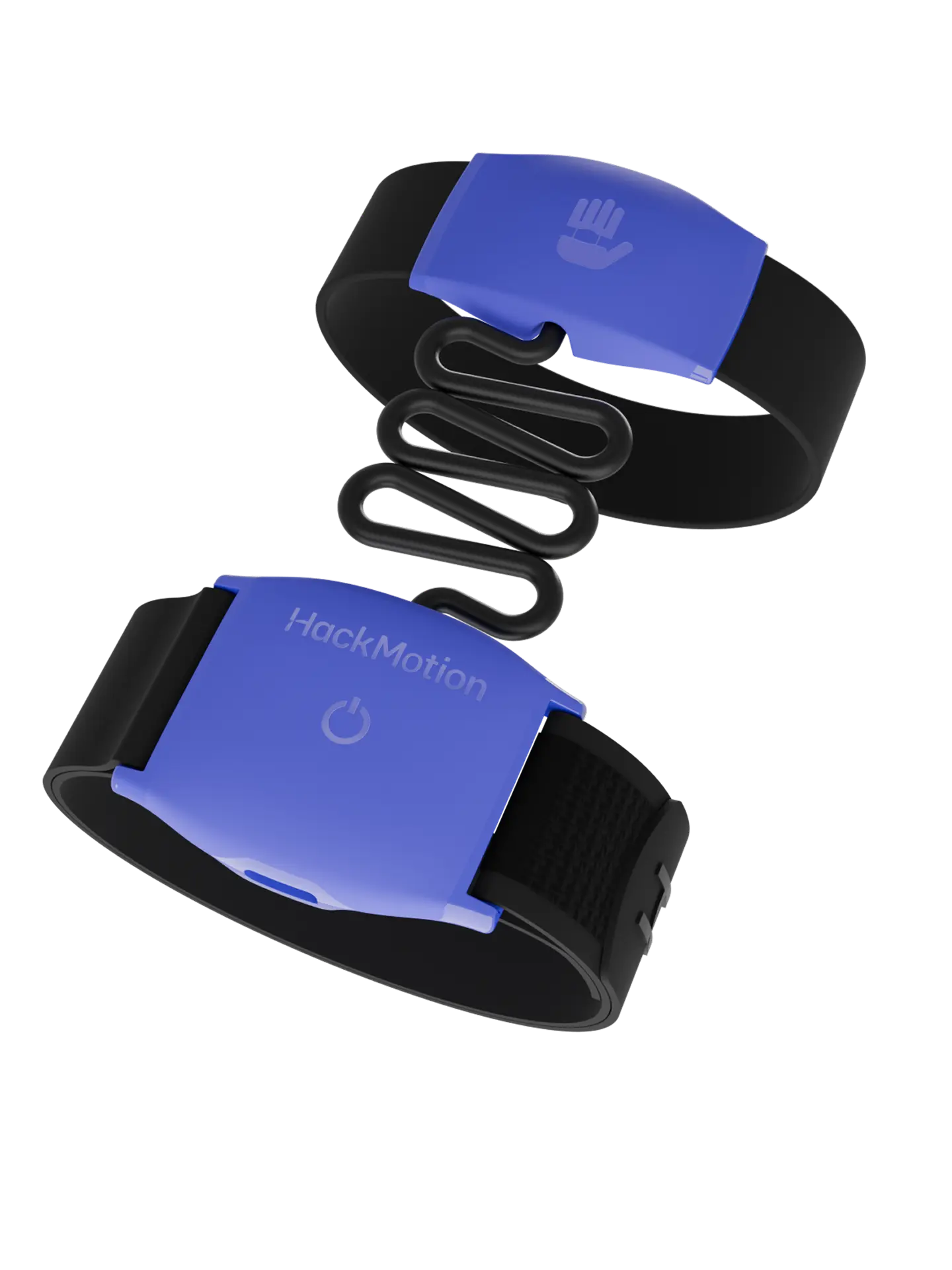
Wrist Angle Sensor · iOS & AndroidMeasures
Lead wrist flexion and extension throughout the swing. Clubface angle at key positions. Radial and ulnar deviation. Wrist movement during putting stroke (Plus and Pro tiers). Benchmarks against PGA Tour player data (Pro tier). 800 measurements per second.
NO SUBSCRIPTION — EVER
HackMotion is a one-time hardware purchase. The app, all software features, and all future updates are included in the purchase price with no recurring subscription. Hardware is identical across all tiers — upgrade from Core to Plus or Pro in software only, no new sensor required.
Core — €275 (approx £234)
Was €345 · Save €70
Full swing virtual coach. Full swing analysis. Personalised drills and swing thoughts. App access. No subscription.
Plus — €420 (approx £357)
Was €490 · Save €70
Everything in Core plus putting virtual coach, putting analysis, and putting drills.
Pro — €915 (approx £778)
Was €985 · Save €70
Everything in Plus plus Tour player comparisons, advanced wrist metrics for lead and trail wrist, and multiple player profiles. Designed for coaches and serious players tracking multiple students or swing types.
Pricing in Euros. No subscription ever — one-time purchase. Software tier upgrades do not require new hardware. 60-day money-back guarantee. 2-year warranty. Free worldwide shipping. HackMotion Sensor 4 now shipping — 25% smaller than previous generation, doubled processing power, improved haptic feedback.
Our view
HackMotion is Golf Monthly's top-rated swing analyser in 2026 and the most credible wrist sensor available to club golfers. The proposition is precise: your wrists are the only connection between your body and the club, and they control the clubface. Fix the wrist motion, fix the face angle, fix the ball flight.
The sensor measures at 800 frames per second with zero lag — when you move your wrist, the 3D hand model in the app mirrors it instantly. That immediate feedback loop is what makes the device genuinely useful for building new movement patterns rather than just measuring existing ones. The app diagnoses swing faults automatically and selects drills from a library built by PGA coaches, presenting them with colour-coded feedback — green for on-target, red for outside range. A golfer without technical knowledge can still act on the data.
The Core tier at approximately £234 is the right starting point for most club golfers. It covers full swing coaching, analysis, and drills. If putting consistency is also a priority, Plus at approximately £357 adds the putting suite. The Pro tier at approximately £778 is designed for coaches and technically advanced players who want Tour comparison data and multiple profile support.
The no-subscription model is a significant practical advantage. Pay once, use indefinitely. And crucially, the hardware is identical across all tiers — if you start with Core and decide you want putting analysis later, you upgrade the software without buying a new sensor. That is not common in this category.
The Sensor 4, released May 2026, is the current hardware. It is 25% smaller than its predecessor with doubled processing power — genuinely more comfortable on the wrist and better positioned for future software features. If you are buying new, the Sensor 4 is what you want. The older Sensor 3 remains available at a reduced price while stocks last if cost is the primary consideration.
The honest limitation: HackMotion measures one thing very well — wrist mechanics. It does not measure tempo, club path, swing plane, or ball flight. For golfers whose primary fault is caused by wrist breakdown — scooping, cupping, inconsistent clubface at impact — it is one of the most direct and measurable tools available. For golfers whose faults lie in body rotation, weight transfer, or swing plane, the data will be less relevant to their specific improvement needs.
- Best for
- Golfers struggling with clubface control, a persistent slice or hook caused by wrist breakdown, scooping at impact, or inconsistency that stems from lead wrist position. Also widely used by PGA professionals as a coaching tool.
- Verdict
- The most credible wrist sensor available. Core at approx £234 is the right starting point — same hardware across all tiers means you are never locked in. No subscription, 60-day money-back guarantee.
- Worth it?
- Yes for golfers with specific wrist-related faults — particularly clubface control issues or persistent directional misses. Start with Core. The 60-day money-back guarantee makes the trial genuinely risk-free. Sensor 4 is the current hardware to buy.
Blast Motion Golf
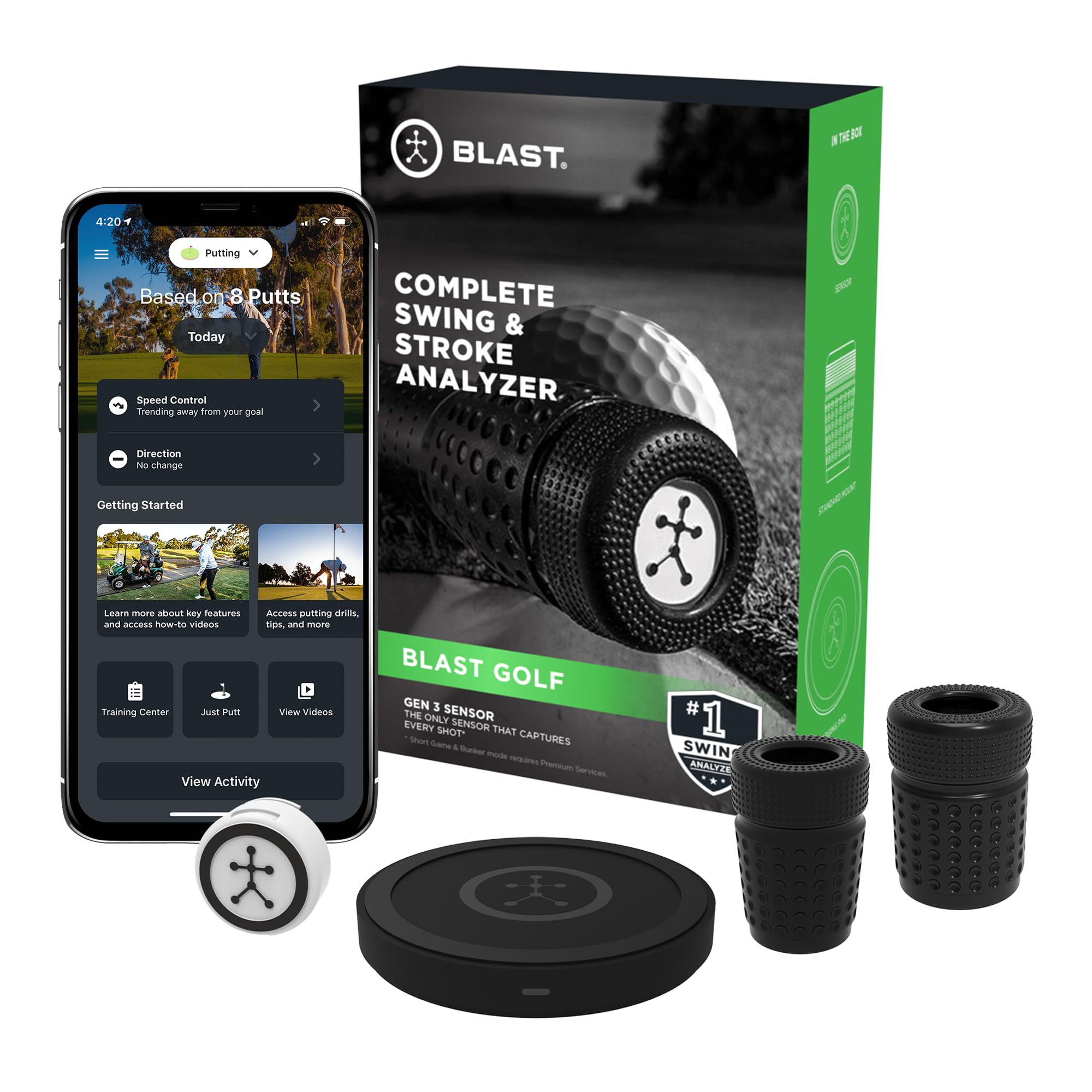
Grip-End Swing & Stroke Sensor · iOS & AndroidMeasures
Full swing: tempo ratio, backswing and downswing time, swing speed, peak hand speed, attack angle. Putting: face angle at impact, backstroke and forward stroke time, tempo ratio, stroke length, loft change, lie change. Short game and bunker: same timing and angle metrics as full swing. All measurements benchmarked against Tour player ranges by handicap level.
ATTACHMENT NOTE
The sensor attaches via a rubber sleeve that slides over the butt of the grip, adding approximately 2 inches to the club length. Most golfers adjust within a few sessions, but the attachment can be fiddly on thicker putter grips. Golf Monthly's reviewer flagged this as the main practical frustration. If you use a non-standard oversized putter grip, check compatibility before purchasing.
Sensor — $119.96 (approx £94)
Regular $149.95 (approx £118)
Includes sensor, club attachment, and 1 month of premium subscription. Core tracking features free in the app after trial month. Premium Services (remote coaching, video analysis, player reports) are for coaches and require ongoing subscription. iOS and Android. Used by 200-plus Tour professionals. Attaches to the butt end of any club via rubber sleeve. No calibration required. Tracks every swing and putt automatically — detects practice swings separately from real shots. Smart video capture clips each swing with metrics overlaid in the app. Blast iQ gives green/yellow/red assessment with improvement recommendations after every swing. Air Swings mode works without hitting a ball. Training Centre with Tour player benchmarks by handicap level and club type. Works across full swing, short game, bunker shots, and putting. 350 million-plus swings tracked.
Pricing in US dollars. Core tracking features are free in the app after the included trial month — no ongoing subscription required for personal use. Premium Services subscription is designed for coaches. Verify current pricing before purchasing.
Our view
Blast Motion's strongest case is putting and tempo. Of all the metrics the sensor captures, the putting data is the most consistently praised in independent reviews — face angle at impact, stroke timing, and the backswing-to-forward-stroke ratio are the numbers that matter most for putting consistency, and Blast captures them accurately against Tour benchmarks broken down by handicap level.
The tempo feedback for the full swing is similarly useful. The app displays your backswing-to-downswing ratio on a clear speedometer-style gauge with Tour ranges by club type and handicap. Most golfers who use it discover their tempo is faster than they assumed — the difference between perceived rhythm and actual rhythm is often surprising, and visible within a single session.
At approximately £118 with no ongoing subscription for core features, Blast Motion is the most affordable hardware product in this guide. The Air Swings mode means you can practise at home without hitting balls — useful for winter training or indoor work on tempo and putting stroke mechanics.
The metrics list is extensive across putting, short game, and full swing. The honest limitation from multiple independent reviews is that the full swing data has its constraints — swing path, face-to-path relationship, and impact location are not captured. Club speed figures have been questioned by some reviewers when compared against launch monitor data. Golf Insider UK summarises it clearly: the metrics for full swing are useful for tempo and speed work but less useful for golfers seeking accuracy and clubface control. For those needs, HackMotion goes significantly deeper.
Golf Monthly found the grip attachment the primary friction point — fiddly to install and adding length to the club until you adjust. The app itself is described as intuitive and well-presented once the sensor is in place.
- Best for
- Golfers working specifically on putting stroke consistency and tempo. The most accessible and affordable entry point into sensor-based swing data. Also widely used for putting practice by Tour professionals who rely on the face angle and timing metrics.
- Verdict
- At approx £118 with no subscription for core features it is the most affordable sensor in this guide. Best results from putting and tempo work. Manage expectations on full swing accuracy data beyond timing metrics.
- Worth it?
- Yes for golfers focused on putting and tempo improvement. The price and no-subscription model for core use make it a sensible first sensor purchase. If clubface control is your primary issue, HackMotion addresses that more directly.
Arccos Golf
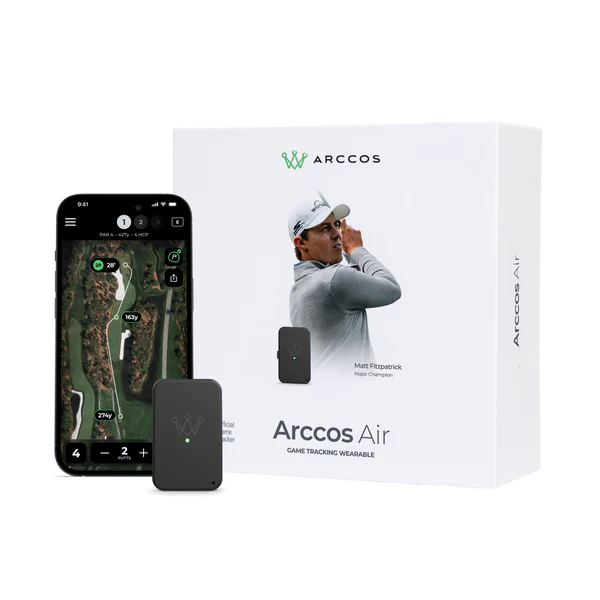
Automatic Shot Tracking System · iOS & Android · Apple Watch · Official Game Tracker of the PGA TourMeasures
Every shot hit on course — automatically. Smart Club Distances based on your actual performance, not averages. Strokes Gained across driving, approach, short game, and putting. Fairways hit, greens in regulation, putts per round. AI-adjusted distances for wind, slope, temperature, altitude, and humidity. Does not measure swing mechanics.
DIFFERENT FROM SWING SENSORS
Arccos is not a swing mechanics sensor. It does not measure wrist angles, club tempo, or swing plane. It records every shot you hit on the course automatically and turns that data into performance analytics. We have included it here because it is frequently compared alongside HackMotion and Blast Motion, but it solves a different problem: it tells you where you lose shots across a full season of real rounds, not what is happening in your mechanics. If you want swing mechanics feedback, HackMotion or Blast Motion are the relevant products.
Arccos Air
£309.99
The new AI wearable. Slip it in your pocket and play. No club sensors required. AI trained on 1.5 billion shots detects every shot automatically. First year of Game Tracking subscription included.
Arccos Smart Sensors (14 sensors)
£224.99
14 sensors that screw into the butt of each club grip. First year of Game Tracking subscription included.
Air + Smart Sensors Bundle
£374.98
Automatic shot detection — no tapping or manual input. Smart Club Distances built from your actual shot history. Strokes Gained analytics by category. AI Strategy — hole-by-hole plan based on your data, course layout, wind, and pin position (iOS). Smart Laser integration for precise Plays Like distances. Live Activity on Lock Screen and Dynamic Island (iPhone). Apple Watch support. 40,000-plus courses worldwide. Works with Arccos Air, Smart Sensors, Smart Grips, and Smart Laser.
Game Tracking subscription (from year 2)
Approx £130–£160/year
Ongoing subscription required from year 2 for AI Caddie, Strokes Gained analytics, and Smart Club Distances. First year included with any hardware purchase. Check current UK price at uk.arccosgolf.com before subscribing.
All UK prices from uk.arccosgolf.com. First year subscription included with any hardware purchase. Green Maps feature currently US only — not yet available to UK golfers. AI Strategy available to iOS subscribers. 30-day money-back guarantee.
Our view
Arccos solves a different problem from every other product in this guide. It answers the question: where am I actually losing shots? Not in a general sense — specifically, by club, by hole type, by condition, relative to golfers at your handicap level.
The Strokes Gained analysis is where the platform earns its credibility. After ten or fifteen rounds, Arccos gives you objective data on your actual club distances — not what you think you hit your 7-iron, but what you actually averaged over your last 20 tracked shots. It shows which parts of your game are costing strokes compared to golfers at your level. For many club golfers this is genuinely revealing — the data often shows the majority of strokes are lost on approach shots or short-range putting, not the driving most golfers practise obsessively on the range.
The Arccos Air, launched in 2026, is the simplest entry point. Slip it into your pocket, play your round, and the device uses AI to detect every shot without any sensors on your clubs. The existing Link Pro device has been upgraded to Arccos Air automatically via firmware for existing users — no new hardware required. For new buyers, Arccos Air at £309.99 with the first year free removes all the sensor installation friction that previously put golfers off the platform.
The Smart Sensors at £224.99 remain the right choice for golfers who want club-by-club tracking accuracy — the AI in Arccos Air is very good, but the sensors know exactly which club you used on every shot without any inference.
The AI Strategy feature maps the optimal way to play each hole based on your personal performance profile — the same probabilistic course management that Tour caddies apply, made available from your own data. Matt Fitzpatrick used Arccos AI strategy when winning his major championship.
A UK-specific note: Green Maps, which show LiDAR-mapped slope and break data on greens, are currently US only. This is a meaningful omission for UK golfers compared to the full US product experience.
The subscription is the honest decision point. The first year is included with any hardware purchase. From year two the ongoing cost is approximately £130 to £160 per year. For a golfer who plays 20-plus rounds a year and will genuinely engage with the data between rounds, the cost is well justified. For occasional golfers who are unlikely to review their analytics, the value equation is harder. The first year gives you enough data and experience to make that call clearly before renewing.
- Best for
- Golfers who play regularly and want objective data on where they lose shots across a full season. Most valuable for players who track their handicap, compete, or want data-driven practice priorities. Arccos measures what happens on the course — not swing mechanics.
- Verdict
- The most complete automatic shot tracking system available. Arccos Air at £309.99 with first year free is the cleanest entry point. The ongoing subscription is the main consideration — the first year tells you whether you will use the data enough to justify renewing.
- Worth it?
- Yes for regular golfers who will actively use Strokes Gained analytics and AI Strategy. The first year is effectively included — use it to assess whether the data changes how you practise before committing to the subscription. Note that Green Maps are currently US only for UK golfers.
A note on deWiz
deWiz is no longer available.
deWiz was a wrist sensor that measured arm structure and swing depth — a direct competitor to HackMotion that gained a following among serious amateurs and tour-connected teaching professionals. In February 2025, deWiz AB filed for bankruptcy. The product is no longer available for purchase and active subscriptions were discontinued.
In March 2025, the deWiz technology and assets were acquired by Movionics, a motion capture and sports technology company. Movionics has indicated plans to develop the technology under their platform, but no consumer product has been released under the Movionics brand at the time of writing. We will update this guide when a successor product becomes available.
If you are researching deWiz as a potential purchase — do not buy. The product is discontinued. HackMotion is the most direct current alternative for wrist mechanics measurement.
By use case
Which sensor is right for your game?
Wrist mechanics fault
I have directional misses I cannot fix.
If you consistently miss left, right, or with a specific shape despite practising, there is likely a measurable mechanics fault. HackMotion gives you real-time wrist-angle feedback during practice so you can feel and correct the fault in the moment rather than guessing.
- HackMotion Core
real-time wrist angle feedback, direct relationship to clubface angle at impact
Putting stroke mechanics
I three-putt too often.
Three-putting is almost always a distance control or consistency issue. Blast Motion measures tempo ratio, impact zone, and stroke quality on every putt. If your backstroke-to-forward-stroke ratio is inconsistent or you are decelerating through the ball, you will see it clearly.
- Blast Motion Golf
tempo ratio, impact zone, and stroke quality measurement for putting
Round-by-round performance tracking
I want to know where I am losing shots.
If your goal is a lower handicap and you are not sure where to direct practice time, Arccos maps exactly where shots are being lost across a full season — by club, by category, and relative to golfers at your level.
- Arccos Caddie
Strokes Gained by category, personal distance averages, AI Caddie recommendations
Full comparison
All 3 sensors compared.
| Product | What It Measures | Price | Subscription | Platform | Best For |
|---|---|---|---|---|---|
| HackMotion | Wrist angles, clubface control | £234–£778 | None ever | iOS & Android | Clubface control, wrist mechanics |
| Blast Motion Golf | Tempo, putting, timing | ~£118 | None for core features | iOS & Android | Putting & tempo |
| Arccos Golf | Every shot on course | £225–£310 hardware | ~£130–£160/yr from yr 2 | iOS & Android | On-course performance data |
Prices approximate in GBP at time of writing. HackMotion and Blast Motion priced in US dollars — exchange rate applies. Verify current pricing before purchasing.
Related guides
More swing analysis guides.
Six phone-based swing analysis apps reviewed — from free auto-capture to 3D body motion analysis.